Viruses of Cacti: Transmission Through Grafting, Mechanical Spread, and Control Methods
A brief scientific overview for cactus collectors
Viral diseases are one of the most underestimated problems in cactus collections. Unlike fungal or bacterial diseases, viruses often remain invisible for a long time, while slowly spreading through a collection during routine operations such as grafting, propagation, repotting, and plant handling.
For cacti this is especially important because most collections rely heavily on vegetative propagation and grafting, which creates ideal conditions for virus transmission.
What viruses occur in cacti
The most commonly reported viruses affecting cacti include:
-
Cactus virus X (CVX)
-
Schlumbergera virus X
-
Zygocactus virus X
-
Cactus mild mottle virus (CMMoV)
-
Carlavirus-like viruses
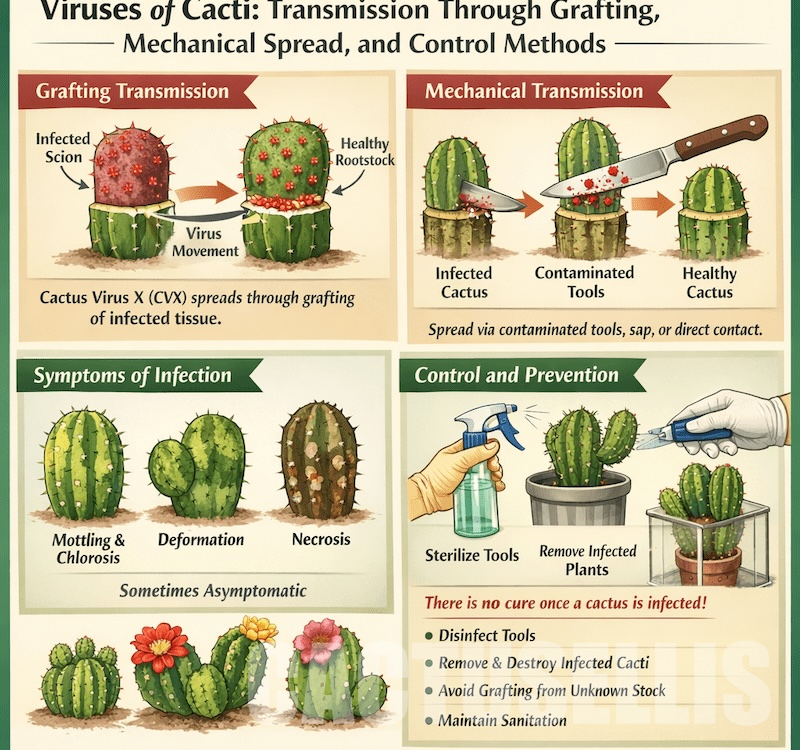
Among these, Cactus virus X is considered the most widespread. It infects many cactus species and may cause mosaic patterns, chlorosis, necrosis, and tissue deformation, although many infected plants remain symptomless carriers.
(Source: ScienceDirect)
Viral infections in cacti are frequently latent, meaning infected plants may appear perfectly healthy.
(Source: ResearchGate reviews)
Virus transmission during grafting
Grafting is one of the most efficient ways viruses spread in cactus collections.
During grafting the vascular tissues of the rootstock and scion connect. Once vascular continuity is established, viruses can move freely between the two plants.
If one of the plants is infected, the virus can move:
-
from rootstock to scion
-
from scion to rootstock
This process is particularly dangerous when performing large numbers of grafts.
Mechanical transmission of viruses
Besides grafting, viruses often spread mechanically.
Mechanical transmission occurs when virus-containing plant sap enters wounds on healthy plants.
A typical infection sequence looks like this:
-
A cut is made on an infected plant
-
Sap contaminates the knife or blade
-
The same tool is used on another plant
-
The virus enters the fresh wound of the healthy plant
Even a very small amount of contaminated sap may be sufficient to start an infection.
Research has shown that Cactus virus X can be transmitted through contaminated cutting or grafting tools.
(Source: Crop Protection journal)
Some cactus viruses have also been experimentally transmitted mechanically to indicator plants, confirming that sap transmission is a real and important pathway.
(Source: Scielo plant pathology study)
For many plant viruses, including tobamoviruses, mechanical transmission through tools or hands is the primary mode of spread.
(Source: PMC plant virology review)
Why viruses spread quickly in collections
In natural habitats, infection spreads relatively slowly.
In collections the situation is very different because:
-
plants are kept very close together
-
grafting is performed frequently
-
vegetative propagation is common
-
the same tools are used repeatedly
-
plants are exchanged between collectors
For this reason, a single infected plant may become the source of infection for an entire collection.
Symptoms of viral infections in cacti
Symptoms can vary widely depending on the virus and host species.
Typical symptoms include:
surface symptoms
-
mosaic patterns
-
light or dark patches
-
ring spots
-
chlorosis
-
reddening of tissues
growth abnormalities
-
stem deformation
-
distorted segments
-
abnormal areole formation
-
reduced growth
For example, in prickly pear cactus infections have been associated with chlorotic rings, mottling, and discoloration of tissues.
However, many infected plants show no visible symptoms, which makes viruses particularly dangerous for collectors.
Can viral infections be cured?
At present there is no effective treatment for plant viral diseases.
Once a cactus becomes infected, the virus remains present in the plant for life.
Therefore, management strategies focus on preventing spread rather than curing infection.
Control and prevention methods
1. Tool sanitation:
This is the most important protection for any cactus collection.
Recommended practices include:
-
using disposable blades
-
disinfecting tools after each plant
-
cleaning working surfaces
Common disinfectants include:
-
sodium hypochlorite solutions (bleach)
-
alcohol solutions
-
chlorhexidine
-
specialized disinfectants
Tool sanitation is widely recognized as the key measure to prevent virus transmission in plant collections.
2. Quarantine of new plants:
Any newly acquired plant should be kept separate from the main collection.
Recommended quarantine period:
2–6 months
During quarantine:
-
observe plants for symptoms
-
avoid using them for grafting
3. Separation of plant groups:
Ideally collections should be divided into separate zones:
-
collection plants
-
propagation plants
-
newly acquired plants
This reduces the risk of spreading infection through the entire collection.
4. Destruction of infected plants:
If a viral infection is confirmed or strongly suspected, recommended measures include:
-
removing the plant from the collection
-
destroying infected plant material
-
discarding the substrate
-
disinfecting the pot
This approach is commonly used in professional nurseries.
What to do with rare collector plants:
Collectors sometimes choose to keep rare infected plants.
Possible precautions include:
-
strict isolation
-
avoiding propagation
-
keeping the plant away from the main collection
However, it is important to remember that any grafting or cutting from such plants may spread the virus further.
Conclusion:
Cactus viruses represent a hidden but very real threat to plant collections.
The main pathways of transmission are:
-
grafting
-
mechanical transmission through sap
-
contaminated tools
-
plant contact
The most effective protection for a cactus collection includes:
-
sterile tools
-
quarantine of new plants
-
isolation of suspicious specimens
-
removal of infection sources
These simple practices can significantly reduce the risk of virus spread in cactus collections.
Sources for photos for review and knowledge:
PlantVillage
https://plantvillage.psu.edu
A large database of plant disease images.
References:
-
Evallo et al. 2021 — A brief review of plant diseases caused by Cactus virus X (Crop Protection).
-
UCANR — Viruses and Viral Diseases of Cacti and Succulents.
-
Alonso Barrera et al. — Mechanical transmission of potexvirus in cactus (Scielo).
-
Duarte et al. — Characterization of cactus viruses (CABI Digital Library).
-
Ortega-Acosta et al. — Virome of prickly pear cactus.
-
Casper R. — Early description of cactus virus X (Journal of General Virology).
-
Kan Y. 2025 — Transmission of tobamoviruses by mechanical contact (PMC).
-
International Society for Horticultural Science — Symptoms of virus infection in cactus.

Can a cactus infected with a virus be supported?
A virus remains in the plant for its entire life, so curing it is impossible. Control of viral diseases is mainly based on sanitation, removal of infected plants, and prevention of the spread of infection.
However, there are ways to strengthen the plant’s immune system so that it can better tolerate the infection.
1. Plant immune stimulators
Some substances activate Systemic Acquired Resistance (SAR) in plants — a systemic immune response in which the plant strengthens its defense mechanisms against pathogens.
Examples of such substances:
-
salicylic acid
-
jasmonic acid
-
seaweed extracts
-
chitosan
-
plant immune activators
These substances do not destroy the virus, but they can:
-
reduce the rate of virus replication
-
decrease the severity of symptoms
-
increase tissue resistance
These effects are associated with increased synthesis of defense proteins and phenolic compounds in plants.
2. Beneficial microorganisms (biological protection)
Some bacteria and fungi are capable of stimulating plant immunity.
For example:
-
Bacillus spp.
-
Pseudomonas spp.
-
Trichoderma
They activate what is known as Induced Systemic Resistance (ISR).
Effects include:
-
a stronger immune response in the plant
-
reduced disease symptoms
-
improved growth even in the presence of viral infection.
3. Anti-stress preparations
Although these products do not act directly on the virus, they help the plant tolerate infection more effectively.
In practice, the following are commonly used:
-
amino acids
-
humic acids
-
seaweed extracts
-
plant vitamins
Such preparations:
-
reduce stress
-
stimulate growth
-
help the plant compensate for tissue damage.
4. Nutrition and micronutrients
Plants infected with viruses are particularly sensitive to nutrient deficiencies.
For proper support, the following are important:
-
magnesium
-
potassium
-
calcium
-
micronutrients (Fe, Mn, Zn)
Adequate nutrition can help reduce the severity of viral infection symptoms.